How categorizing information unlocks real growth
We Start by Remembering Everything
When we’re young, we don’t know what’s important—so we try to remember everything.
This is a survival strategy. As children, we have no filter yet. Every detail might be relevant. Every experience is new. So the brain records it all, and only later do we begin to form patterns—mental shortcuts to make sense of the world.
But those patterns don’t form randomly. We test them. If a pattern helps us avoid pain or gain pleasure, we reinforce it. Everything else—the memories and data that don’t serve the pattern—starts to fade. Slowly, we stop remembering “everything” and start remembering only what fits.
That’s not a flaw. That’s how memory is supposed to work. But it comes with a hidden cost.
The Problem With Growing Up
By the time we’re adults, our minds are packed with these well-worn mental models. So packed, in fact, that we often stop forming new ones.
Some patterns contradict each other. Others actively prevent us from learning—by triggering discomfort or avoidance anytime we encounter information that doesn’t fit.
And this is where the real danger lies:
We stop learning not because we can’t, but because our patterns won’t let us.
This is why so many adults find it hard to change, grow, or even enjoy life differently than they used to. The very patterns that helped us once are now limiting us.
Perfect. Based on your feedback, here’s the refined and fully integrated “What Is Wisdom?” section, with a smooth progression from awareness levels to Stoic caution to Buddhist depth. It now reads as a unified whole, without any on-the-nose transitions or disconnected references:
What Is Wisdom?
At its core, wisdom is the ability to step back from your automatic thoughts, challenge your assumptions, and act in ways that are aligned not just with your immediate interest, but with deeper insight and broader understanding.
Early on, we think in self-centered terms:
What do I want? What’s fair to me?
As we grow, we begin to see more perspectives:
What does the other person want? What would benefit my team, my community, my world?
Psychologist Susanne Cook-Greuter mapped this developmental shift as an evolution in meaning-making—where each stage of awareness builds on the last, expanding what we can hold in mind and heart. It’s not just about being smarter. It’s about seeing further—and knowing when to zoom in or out.
Take a simple situation: You’re working on a project with a colleague. A disagreement comes up.
Your first instinct is to push your idea through. You’re sure it’s better. But then you pause.
You realize: They probably feel the same about their idea. And maybe neither of you is wrong.
At a higher level of awareness, it’s clear the real goal isn’t winning the argument—it’s creating the best outcome together. You can even take a small personal loss now, because doing so increases the chance of success in the larger goal.
This is wisdom in motion: shifting levels, choosing the frame that serves the moment best.
But here’s a word of caution—don’t get lost in the clouds.
The temptation of thinking broadly is to drift into areas where your influence disappears.
Yes, your boss plays a role in the company’s culture, which reflects industry trends, which are shaped by economics and geopolitics—but you don’t control all that.
As Marcus Aurelius put it:
“You have power over your mind—not outside events. Realize this, and you will find strength.”
Wisdom isn’t about abstract awareness alone.
It’s also about anchoring yourself in what you can affect.
The next word you say. The next action you take. The next thought you choose to believe or discard.
And once you’re grounded in that—once you’ve chosen the right level of awareness for the task and focused on what’s within your reach—there’s still one more step.
You have to ask: Why does this matter?
And: What if even this assumption is wrong?
Even our clearest thoughts can be part of the illusion.
Just because something feels obvious doesn’t mean it’s true.
Sometimes the strongest obstacle to wisdom is the belief that we’ve already found it.
In Zen Buddhism it is said, that
“Obstacles do not block the path. They are the path.”
A bush might be blocking your way forward, but looking up close you might discover beautiful flowers.
A cherished belief might be the very thing blinding you to a better way forward.
What we thought to be an obstacle might turn out to be a benefit, but
What we thought to be a privilege might also be a hindrance.
When we learn to question even the obvious—not out of doubt, but out of curiosity—we begin to see through the illusions that our own minds have built.
And in those moments of clarity, real wisdom emerges.
Not just the ability to remember facts or analyze patterns—
But the rare skill of seeing reality as it is, and acting from that place with calm, clarity, and care.
A Pattern That Blocks Joy
Imagine this: You’re sitting in a park on a beautiful day. The sun is warm. People are laughing nearby. You have no obligations for the next hour.
But instead of enjoying it, your mind drifts.
“I should be doing something productive.”
“What if I’m wasting time?”
“I haven’t posted on social media in a while.”
That’s a pattern. A voice planted by years of hustle culture or perfectionism.
And even though the moment is objectively good, the pattern steals it from you.
This is what unexamined memory does.
It builds internal rules that can stop us from experiencing joy, peace, or clarity—even when they’re right in front of us.
A Better Strategy Than “Remember Everything”
The answer isn’t to fight your memory.
It’s to change your strategy.
Instead of remembering everything just in case it’s useful, train your mind to sort information:
- Independent Creative Thought — Ideas that arise from your own reflection and critical thinking. These are gold. Write them down. Explore them.
- Informational Input (on a scale of reliability) — News, data, facts, other people’s opinions. These are to be checked, cross-referenced, and tested.
- Disposable Noise — Info with no lasting value, like clickbait, gossip, or shallow trivia. Let it go.
Most of us treat all three types the same. That leads to overwhelm, confusion, and shallow thinking.
But when we shift to focusing deeply on category 1, verifying category 2, and forgetting category 3, we start making space for wisdom to grow.
The Path to Wisdom
True wisdom emerges not from holding onto every detail, but from refining what matters after the details are gone.
You may forget the exact quote, or the article that sparked your insight—but if the insight sticks, you’ve gained something deeper.
Here’s how to practice this:
- Recall often: Think about what you’ve learned recently. If it feels unimportant, let it fade.
- Write regularly: Writing is the best way to filter and test your thoughts. It helps you clarify what you really believe—and what’s worth keeping.
- Get feedback: Share your thoughts. Other perspectives challenge your filters and expose blind spots.
- Stay open: Notice when your patterns push back. That discomfort might be the doorway to a deeper truth.
Closing Thought
We can’t remember everything, and we shouldn’t try.
But we also shouldn’t forget everything either.
Instead, aim for this:
Exchange memory for wisdom.
You might forget the exact recipe for that amazing meal or the title of that perfect song—but what you’ll keep is the ability to find your way back.
To think clearly.
To see through illusion.
To enjoy life, not just remember it.
And that’s the real value of letting go.
Author

sascha@sascharoni.de
Related Posts
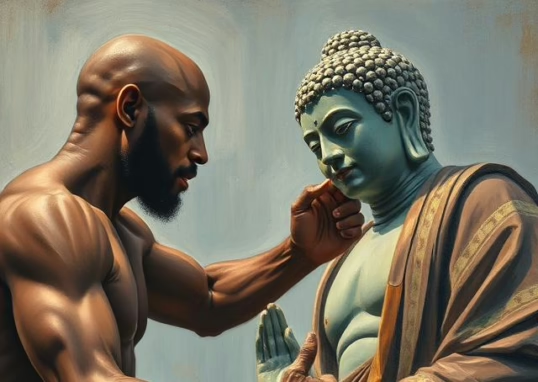
David Goggins vs. The Buddha: Who Wins the War on Addiction?
Why even success is actually failure if you use the willpower method Most people try to change the same way:They pick a...
Read out all
Tomorrow will be worse
A wake-up call to actually live You don’t need a reason to feel good. Most people wait for external events to justify...
Read out all
You’re Not Out of Control — You’re Just Believing a Lie
And No, Willpower Won’t Save You Ever promised yourself you’d stop? No more cigarettes. No more late-night scrolling. No more snapping at...
Read out all
Exploring True Kindness
Introduction Imagine this: you hold the door open for someone, offer them a warm smile, and they walk past without so much...
Read out all
Why We Shouldn’t Just Answer Questions Literally
In our daily lives, we often encounter questions and statements that seem straightforward. We’re asked, “How are you?” or told, “The weather...
Read out all
Tired All The Time? You NEED to know this!
You are missing out.I don’t mean the party you didn’t go to—no!What you’re missing out on is sleep. Whether you’re a party...
Read out all